
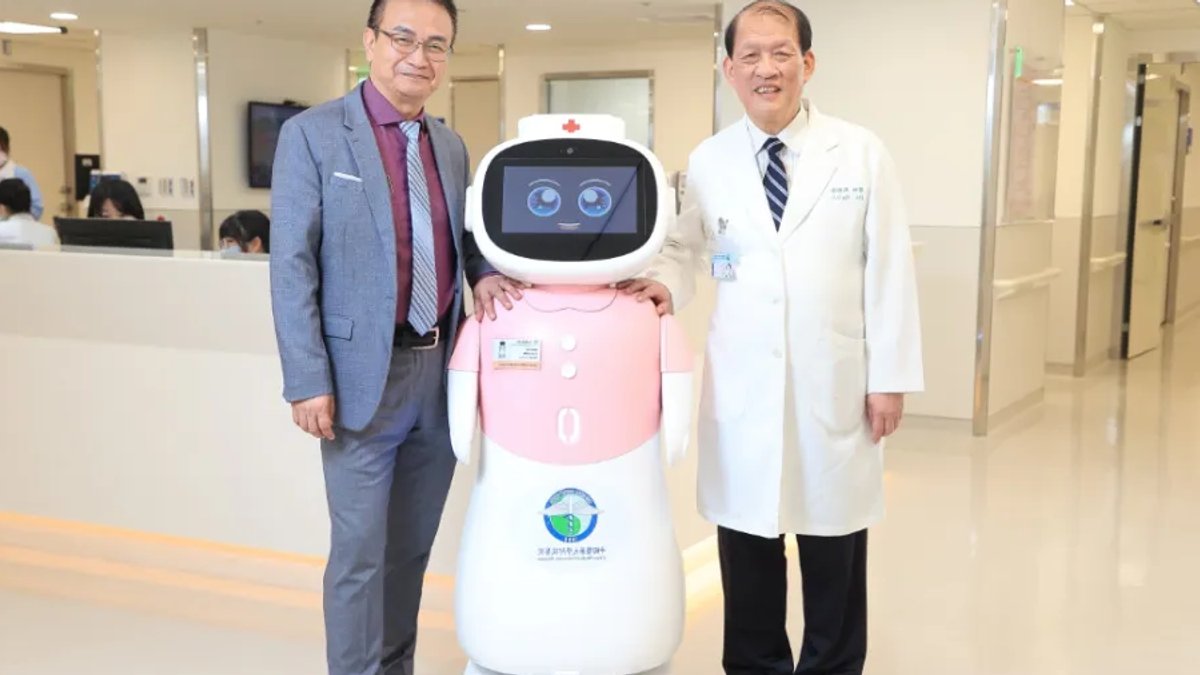
China Medical University Hospital (CMUH) plans to price its hospital-developed care robot below the cost of hiring a nurse. The strategy aims to ease staffing pressures as the demand for healthcare services continues to rise.
Wei-Cheng Chen, chief secretary at CMUH, said that continued reliance on a labor-intensive care model would affect workforce retention, bed capacity, and patient safety. He noted that populations are aging and rates of chronic illness are climbing.
The hospital developed the system, named EirBot, in partnership with EverBot Technology, a CMUH spin-off. They chose to build a custom solution rather than purchasing an off-the-shelf system. Chen explained that CMUH provides the clinical logic, nursing workflows, and governance. Meanwhile, EverBot develops the artificial intelligence models, manufactures the hardware, and handles deployment.
Backend Integration
CMUH Superintendent Der-Yang Cho said a robot that can’t connect to a hospital’s backend systems is merely “a piece of furniture that looks intelligent.”
Related: Weight loss surgery demand drops as drugs rise
Reducing Workload
Yi-Min Hsu, director of nursing at CMUH, said EirBot could take over about 30% of standardized nursing tasks. These responsibilities include ward orientation, patient education, documentation support, and item delivery.
“Preliminary field monitoring found that in selected item delivery and transport workflows supported by EirBot, related nursing walking distance was reduced by approximately 50%,” Hsu said.
The hospital also assessed the robot’s knowledge base using questions from the past three Taiwanese National Nursing Licensure Examinations. Hsu reported that the robot scored above 90 on every exam. The passing score for the exams is 60, and CMUH stated the robot’s performance was comparable to a top-three national result.
Shih-Sheng Chang, director of the AI and Robotics Innovation Centre at CMUH, said EirBot differs from chatbots and wearable devices because it could physically interact with patients, deliver bedside education, and perform ward tasks.
Related: Sunway Medical launches six-in-one cardiac platform
Production and Expansion
EverBot plans to produce about 200 EirBot units this year for subscription-based deployment across major hospitals in Taiwan. About 30 units will initially be installed at CMUH and Taichung Municipal Geriatric and Rehabilitation General Hospital.
The first generation of the robot provides ward orientation, patient-education consultations, item delivery, remote ward rounds, and video communication. Chang said the second generation would add contactless physiological monitoring and environmental sensing to support real-time risk detection and clinical care.
As EirBot expands into post-discharge follow-up, chronic disease management, and home care, Chen said subscription models could eventually extend to government long-term care programmes, insurer-sponsored health management plans, hospital transitional care services, and optional patient-paid services.