
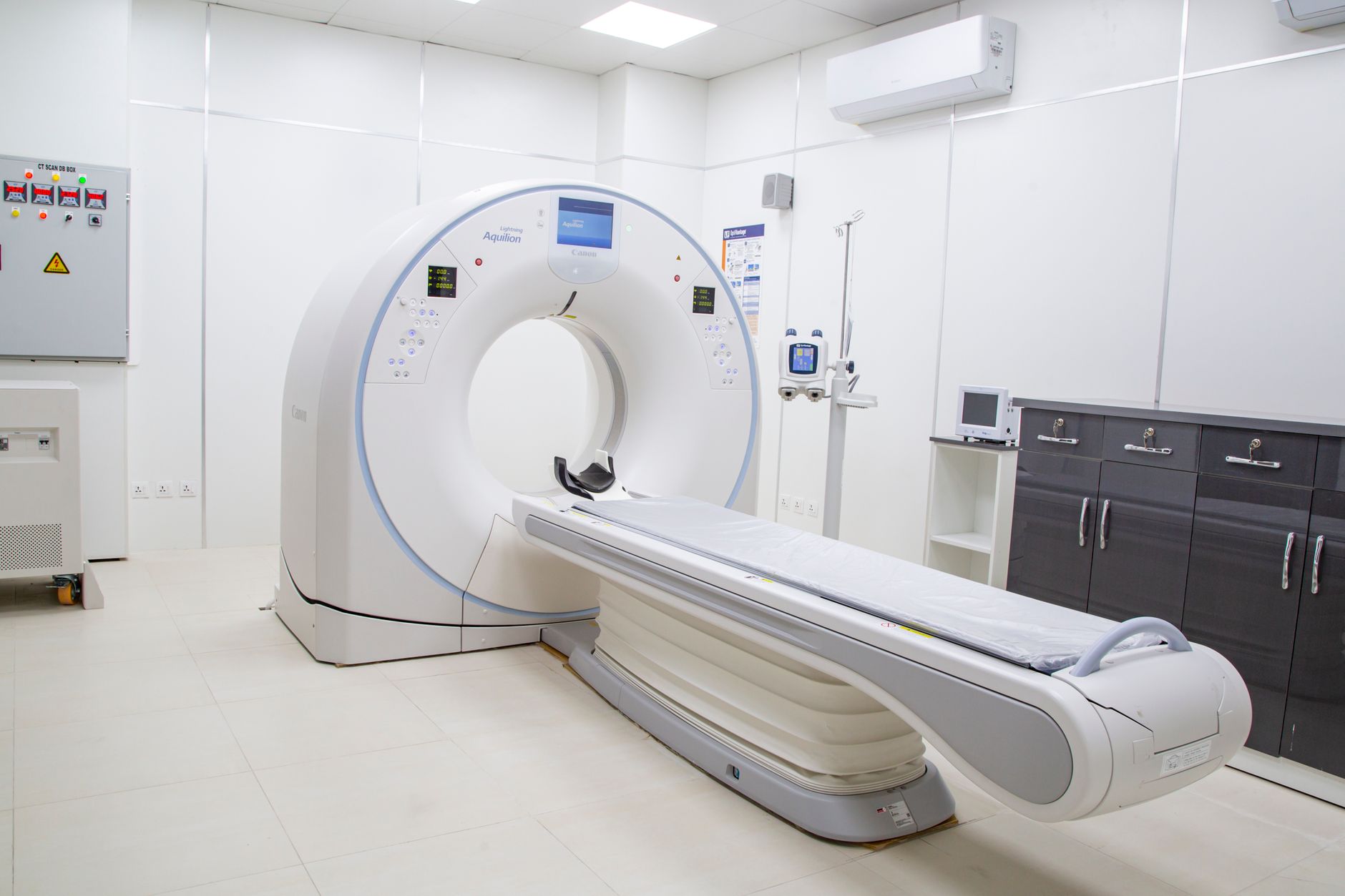
Ultra high-resolution CT (UHR-CT) and photon counting CT (PCCT) systems are becoming increasingly important in medical imaging, particularly in applications that require high spatial resolution. Dunlee has developed extra small, stable focal spots to help optimize image quality, throughput, and heat management in these systems.
The Rise of High-Resolution Imaging
CT imaging is expanding into applications that demand high spatial resolution to achieve images with sufficient detail for diagnostic confidence. Two leading approaches are shaping this trend: UHR-CT, which uses conventional energy integrating detectors (EIDs) with reduced pixel sizes for greater resolution, and PCCT, which incorporates photon-counting detectors that offer higher resolution through smaller pixel sizes as well as spectral imaging capabilities.
These technological advances require equally advanced X-ray sources. Smaller detector pixels necessitate focal spots that are not only smaller, but also thermally and mechanically stable. In addition, high gantry rotation speeds for complex applications such as heart scans demand mechanically stable focal spots regardless of size.
Clinical Applications for High-Resolution CT Imaging
High-resolution CT enables precise visualization of fine structures. Applications include cardiology, where it can be used to visualize coronary arteries and soft plaques, and oncology, where it can be used to identify and characterize small lesions and tumors.
Related: Climate change poses trillion-dollar health risks
Other applications include neurology, where high-resolution CT can be used to detect cerebral microbleeds and small infarcts and evaluate fine neural structures, and pulmonology, where it can be used for detailed lung imaging and detecting interstitial changes.
In orthopedics, high-resolution CT can be used to visualize spongy bone architecture, detect microfractures, and assess implant placement. The extra small focal spots developed by Dunlee have been designed to address the stability needs of daily clinical operations.
Dunlee has over 100 years of experience in developing, producing, and integrating innovative components for imaging systems. The company offers support during development and throughout the product lifecycle, contributing to its customers’ efficient production and go-to-market strategies.
For more information about Dunlee‘s approach to UHR-CT and PCCT, visitors can stop by their booth at the ECR 2026 conference, located in Hall X2, Booth #204, or visit www.dunlee.com to learn more. To learn more about Dunlee’s approach to UHR-CT and PCCT, visit us at ECR 2026, Hall X2, Booth #204.