
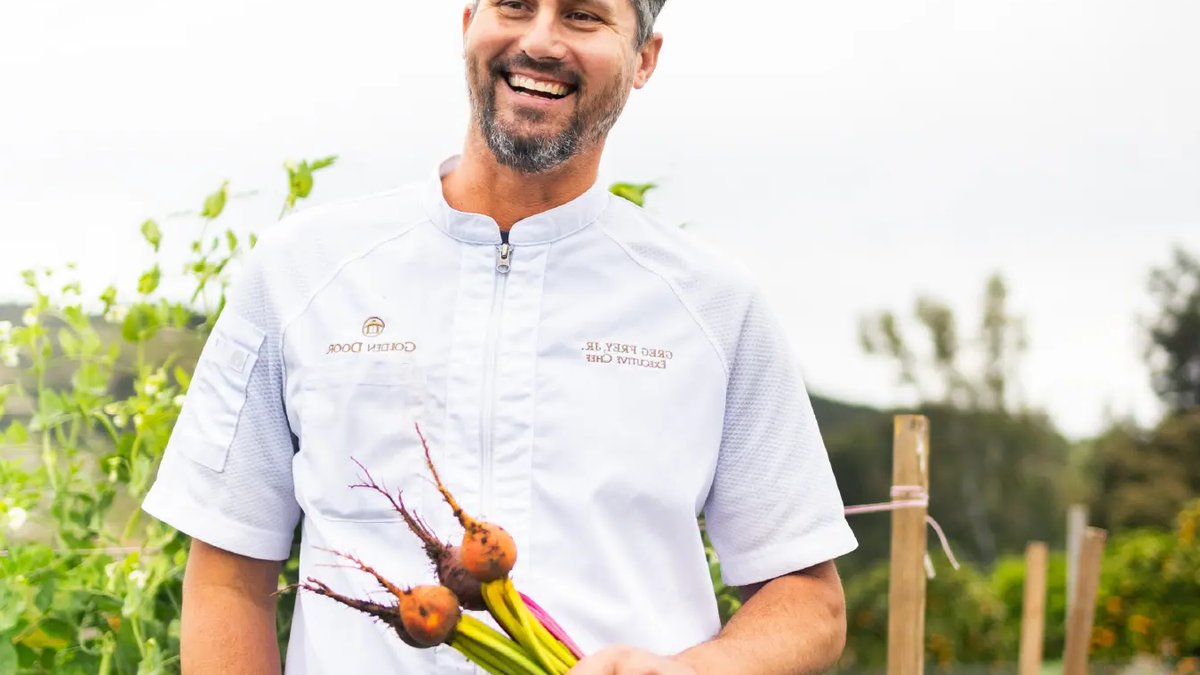
At Golden Door, much of what reaches the plate begins just steps from the kitchen. Executive Chef Greg Frey Jr. recently spent an afternoon walking through the gardens, tasting produce and discussing his approach to food. For Frey, the process starts with good ingredients and the patience to let them do the work. He has refined this philosophy over a career that included stints at Charleston Grill and Bernardus Lodge before spending more than a decade at Golden Door.
Frey helped move wellness cuisine away from restriction and toward food that is seasonal, nourishing, and genuinely enjoyable to eat. This philosophy is central to his newly released cookbook, “The Golden Door Table.” He spoke about the kitchens that shaped him, what cooking at a wellness retreat has taught him, and the simple tricks that make food taste better.
His journey began in Charleston, which he described as the perfect training ground for a young chef. The tight-knit community meant beginners sat next to veterans at neighborhood bars after service. He credits the owners of Charleston Grill with providing the best mentors he could ask for. Later, at Bernardus Lodge, he absorbed the importance of relationships with local farmers, fishermen, and winemakers. That connection to the land formed the foundation of his garden-to-table style.
A Career Shaped by Local Ingredients
He moved through Pamplemousse Grille, which taught him the business side of running a kitchen, and then to Blue Fire Grill. At Blue Fire, he reconceptualized the menu to focus on farm-direct cooking, balancing healthy dining with resort standards. That work solidified his identity as a chef and brought him to Golden Door, where he has served as Executive Chef for over 12 years.
He arrived at Golden Door at a time when the food trend leaned toward austerity. The fare felt clinical and far too strict. Frey believed Golden Door should help people live, enjoy, and appreciate a better life. He wanted to destroy the old stereotype that spa food consists of a hard-boiled egg, a rice cake, and some microgreens. Instead, he sought to show that healthy food represents the bounty of nature.
Read Also: Waking at 3 AM? TCM Links It to Liver Energy
He noted that keeping 41 well-traveled, multicultural guests happy eating at the same place 21 times in a row is a significant challenge. The pressure is on to design menus that feel fresh and exciting every day. To do this, he focuses on ripeness. He advises using your nose to judge fruit; if a package of berries does not smell amazing on the outside, it will not taste like one inside.
Frey also shared his views on splurging versus saving. He believes in investing in vinegars and oils, as quality in those two items makes a ginormous difference in the final dish. On the other hand, it is perfectly fine to be inexpensive with flour, grains, and even sugar, provided the options are the least processed versions available. He mentioned using natural evaporated cane sugar for that reason.
Raising Honey Bees at Blue Fire
He is also known for his work as a beekeeper. While at Blue Fire, the general manager challenged him to develop a unique project. Because the property lacked space for a full garden, the idea shifted to installing beehives to harvest honey. He fell in love with the concept and decided to oversee the project himself.
His cookbook, “The Golden Door Table,” aims to help everyday home cooks. He wants to shatter the myth that healthy cooking is complicated. He noted that the recipes are approachable and do not require trips to twelve different specialty stores. The book is designed to be simple rather than an ego project about luxury.
Frey suggests home cooks start by looking at their plate like a pie chart: one-quarter protein, one-quarter complex carbohydrates, and the entire other half fresh vegetables. He adds that the vegetable half should be a rainbow of colors to ensure a variety of nutrients. He also challenges readers to go completely without salt for three days to reset their palates.