
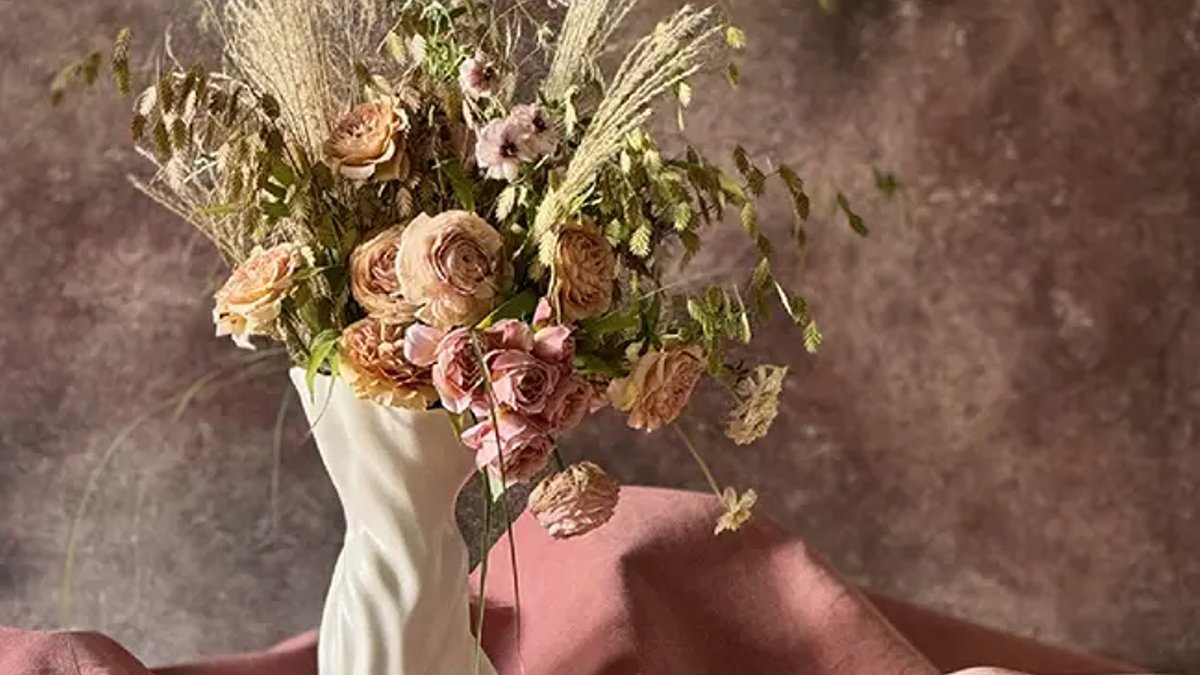
Sullivan Owen spent fifteen years building a reputation as a Philadelphia florist, earning accolades from local publications to features in Vogue and Harper’s Bazaar. Her studio was named Best Florist in the city just six months after opening, and her work appeared in Rizzoli’s In Full Flower alongside emerging talent. But the pandemic changed everything. In 2020, her calendar emptied overnight, forcing her to shutter her studio for nineteen months.
A Garden Detour
With her floral business on hold, Owen turned to a garden renovation at her home. When the summer heat made digging unbearable, she enrolled in a beginner pottery class at The Clay Studio, a nonprofit in Philadelphia. What began as a temporary distraction evolved into four years of self-directed learning in clay chemistry, mold-making, and 3D software. She now operates a home-based lab with printers she built herself, driven by a singular goal: understanding how flowers behave once they land in a vase.
“My day to day looks like a lot of solo-preneurs’: juggling a growing business while pushing new ideas forward,” Owen said in an interview. She explained that her vases were born from firsthand experience with the limitations of modern designer vessels—beautiful on a shelf but impractical for actual flower arrangements.
Designing for Function
Fifteen years as a floral designer taught Owen to notice details most vase makers overlook. “Most people who design and make vases, especially for wholesale, don’t actually arrange flowers themselves,” she said. Her vases prioritize the stems inside first, with folds and ridges that mimic fabric not just for aesthetic appeal but to guide stems into optimal positions. These features create hidden channels where rogue stems can be tucked neatly, ensuring a visually balanced composition above the rim.
The design process begins with hand-sculpting in wax, clay, or mixed media—sometimes combining fabric with Mod Podge. Digital scans of these physical models allow for iterative refinement using 3D modeling software she taught herself. Once satisfied, she prints a full-scale, watertight prototype using plant-based filament. Many designs don’t pass this stage, gathering dust in boxes until revisited later.
Read Also: Breast Surgeon Dispels Breastfeeding Myths
Each piece in her collection evolves uniquely. Draped No. 1 barely changed from its initial wax form to the final porcelain version. Others, like Pedestal No. 1, required nearly three years of iterations and research into form and function. A design is ready when Owen finds herself unable to stop arranging flowers in its 3D-printed version. At that point, she creates a scaled model sent to Oregon for plaster mold production, enabling porcelain manufacturing.
Fashion Meets Floristry
The distinctive folds in Owen’s vases often originate from non-floral inspirations. Draped No. 1 was inspired by her treasured collection of rare tree peonies, which bloom for only five to six weeks annually. She sought a vessel that could showcase their large blooms while allowing each flower to stand out individually. Other pieces draw from gestures—like the feeling of holding garden stems or images from fashion archives.
Owen, whose grandmother was a 1960s fashion stylist, immediately connected the image to Dior’s historical silhouettes. She translated the diagonal folds into a vase shape, widening the opening like a dress neckline and shaping the base to echo fabric movement at the hem.
From Crisis to Creation
Barely Cinched, her first vase design, holds deep personal significance. Created during a period of uncertainty in 2020, it was born from exhaustion with garden work and a desire for indoor creativity. “I was in a dark place, like a lot of people were,” Owen recalled. After building her studio for over a decade, the pandemic halted her livelihood, leaving her feeling unprepared and out of control. She threw herself into manual labor, growing her own plants, moving compost daily, until the heat made it unsustainable. The first pottery class became her escape.
That initial mold, a simple two-part cast of a lightbulb she was obsessed with, taught her slip casting techniques that hand-building couldn’t achieve. “You can achieve folds and wall thicknesses in slip casting that hand-building or throwing can’t touch,” she explained. Making Barely Cinched in her second class session, she crafted it for the small bouquets she gathered during garden walks. Though the mold was rough, the vase itself proved ideal for arranging.
Read Also: Dyson Supersonic r review finds it worthwhile
Instagram users responded enthusiastically, but Owen didn’t pursue sales until 2022, when a client, the mother of a bride, reached out in 2023. She revealed using the vase weekly, sometimes daily, never leaving her kitchen island. “That was the spark for turning it into a collection,” Owen said. Without knowing someone had used and cherished it for a full year, she wouldn’t have had the confidence to invest years in the rest of the line.
Floral Philosophy: Nature in Mind
She criticized traditional tall cylindrical vases for forcing blooms upward, creating unnatural compositions. “The flowers themselves are exactly the same,” she explained. “I’ve just made space for them to behave the way they would in nature.”
Her garden, cultivated during the pandemic, deepened this perspective. Planting bare-root peonies and sowing seeds taught her patience, transforming her from a “cynical New Yorker” to someone who adopts hope. This experience reinforced her belief that flowers’ ephemeral beauty lies in their organic movement, which her vases are designed to preserve.
Owen’s advice for grocery-store blooms reflects this philosophy: “Pull them out, cut every stem to different lengths, and remove anything you don’t love, this is your chance to curate the bunch to your own taste, not anyone else’s.” She recommends adding a single foraged element, a branch or herb, to enhance the arrangement beyond its purchased origins.
Viewing arrangements from all angles requires constant rotation during assembly. “If it’s going somewhere it’ll be viewed from all sides, turn the vase constantly while you’re working,” she advised. This technique ensures balanced visual appeal regardless of the viewer’s perspective.